
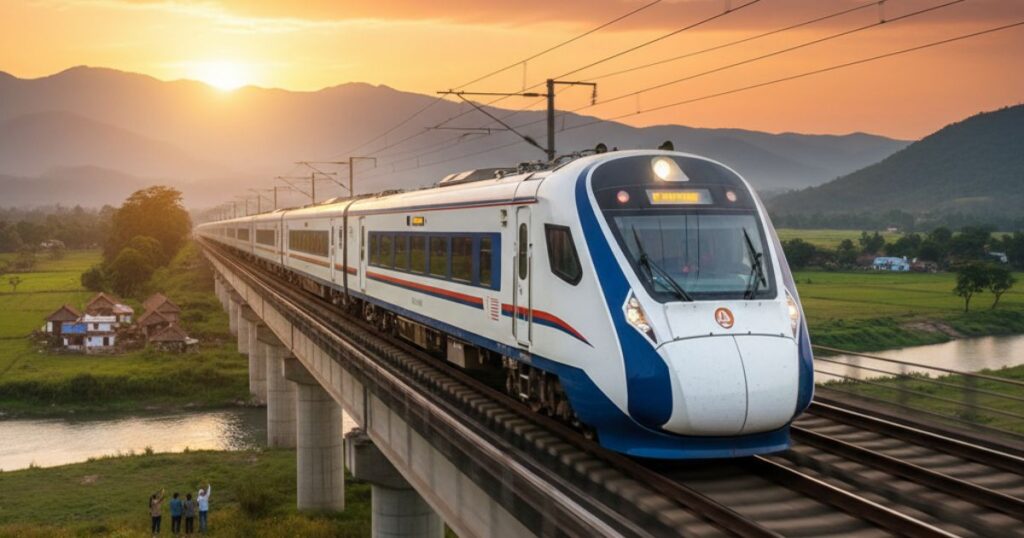
They say, if you want to see the real India — travel by train.
That’s the same advice someone once gave to Mahatma Gandhi.
Because trains in India don’t just carry passengers — they carry stories.
Today, India’s railway routes are connecting the country’s spiritual, cultural, and economic heritage like never before. And at the center of this transformation is the Vande Bharat Express — India’s symbol of speed, innovation, and unity.
This week, four new Vande Bharat trains are being added to the network. These aren’t just trains connecting four directions — they connect four cultures, four economies, and one vision of a new India.
Let’s explore how.
Also Read: Why Delhi Is Called the City That Never Dies
Four Vande Bharat Trains, Four Stories
- Varanasi–Khajuraho Vande Bharat
This route connects the spiritual soul of India.
For the first time, key cultural and religious centers like Varanasi, Prayagraj, Chitrakoot, and Khajuraho are linked through a high-speed train.
The journey will save about 2 hours and 40 minutes for pilgrims.
More importantly, it will boost heritage tourism and strengthen the local economy.
- Lucknow–Saharanpur Vande Bharat
This train connects the heart of Uttar Pradesh, from Lucknow to western UP’s Saharanpur.
Cities like Sitapur, Shahjahanpur, Bareilly, Moradabad, and Bijnor will now enjoy faster, modern connectivity.
The travel time will reduce by one hour, giving a strong push to small-town economies.
It will also make access to Haridwar easier through Roorkee.
- Firozpur–Delhi Vande Bharat
This route acts as a bridge between India’s border and its capital.
Cities like Firozpur, Bathinda, and Patiala will now be just 6 hours and 40 minutes away from Delhi.
The impact will be direct — a boost in trade, agriculture, and logistics.
It will also create new jobs and opportunities in Punjab’s border regions.
- Ernakulam–Bengaluru Vande Bharat
Southern India’s growth story just got faster.
The journey between Ernakulam and Bengaluru will now take only 8 hours and 40 minutes, saving over 2 hours.
This route connects Kerala, Tamil Nadu, and Karnataka — the three engines of South India’s technology, tourism, and trade.
For IT professionals, students, and tourists, this train is a true game-changer.
Best Travel Bags for Vande Bharat Trips
India’s Four Colors – One Vision
If you trace the new Vande Bharat routes on India’s map, you’ll notice they form more than just a network of rail lines — they form a “Vision Map” of India’s growth story. Each route represents a distinct color of India’s identity — spiritual, developmental, economic, and innovative — yet they all blend into one powerful vision: a faster, connected, and united India.
In the north, the Varanasi–Khajuraho route symbolizes the spiritual and cultural heartbeat of India. It connects ancient centers of faith, art, and history — from the ghats of Varanasi to the temples of Khajuraho — creating a seamless corridor of pilgrimage and heritage tourism.
At the center, the Lucknow–Saharanpur route represents growth and employment.
By linking the industrial and semi-urban regions of central and western Uttar Pradesh, it ensures that smaller cities gain faster access to markets, jobs, and opportunities. It’s a lifeline for the new aspirational India emerging beyond metros.
Moving west, the Firozpur–Delhi route embodies trade and national unity. It connects Punjab’s border districts with the national capital, bringing agricultural produce, commerce, and connectivity to the heart of India’s economy.
This route carries both symbolic and strategic value — integrating the border economy with national development.
And in the south, the Ernakulam–Bengaluru route reflects technology and innovation. It connects Kerala’s commercial port city with India’s IT hub, bridging industries, startups, and skilled professionals. It’s not just a route for commuters — it’s a corridor for collaboration, knowledge, and future growth.
Together, these four routes weave a story of One India on the Move —
a nation that honors its past, empowers its present, and accelerates toward its future.
“चार दिशाएं, एक विज़न — तेज़ भारत, जुड़ा हुआ भारत।”

More Than Speed – An Emotional Connection
The story of Vande Bharat is not just about speed — it’s about emotion and pride.
Every time a new Vande Bharat train begins its journey, it carries more than passengers;
it carries the soul of self-reliant India.
It represents the spirit of Make in India,
now running confidently on every track across the nation.
What Will Change with These Trains?
Tourism Boost: Easier access for travelers — from Varanasi to Khajuraho, from Haridwar to Kerala.
Economic Growth: More activity in small towns and border regions.
Social Connectivity: Shorter distances, stronger connections — bringing India closer together.
Green India: Electric trains mean a smaller carbon footprint and cleaner travel.
Conclusion
So yes — these are not just four trains.
They are four directions of progress, one vision, one India.
The Vande Bharat trains represent not just speed —
but the spirit, economy, and self-reliance of a rising nation.
Across every direction, these trains echo one message —
“India is on the move, at its own unstoppable pace.”
Pingback: What Those Stones Under Train Tracks Really Do - indiauncovered.in
Pingback: The Timeless Story of Delhi - indiauncovered.in
Pingback: Kangra: Himachal’s Sacred Land of Faith and Temples - indiauncovered.in
Pingback: Jaipur or Udaipur? The Ultimate Royal Dilemma - indiauncovered.in