
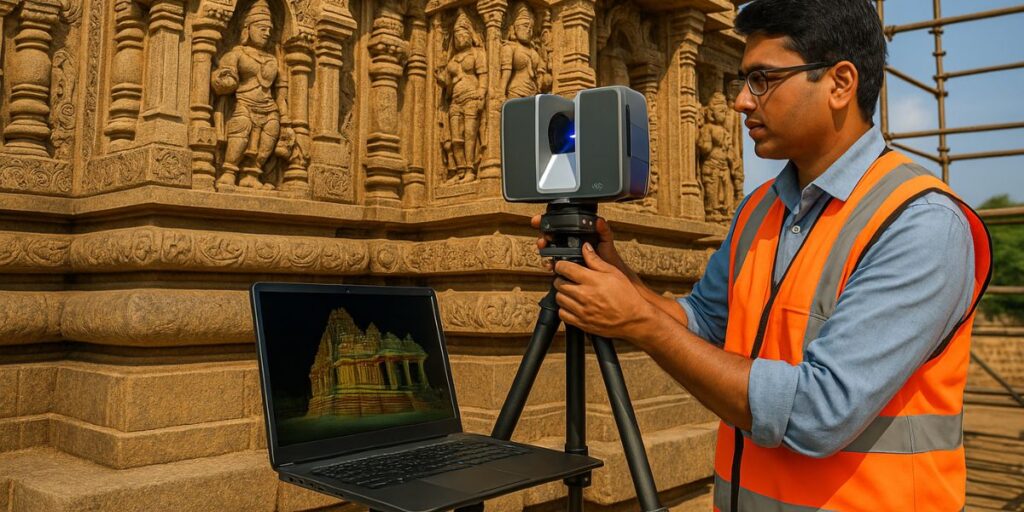
Where Ancient India Meets Modern Innovation
India is home to more than 2 million temples including ancient temples, many of them centuries or even millennia old. These structures are not just religious sites. They are living museums of architecture, astronomy, art, and ancient engineering. But time, weather, neglect, and environmental stress have damaged thousands of them.
Also Read: Kedarnath Ropeway: Devotion Meets Technology in the Lap of the Himalayas
Today, for the first time in history, India is using advanced technologies like LiDAR, 3D scanning, AI modelling, digital archiving, structural health monitoring, and ground-penetrating radar to restore its sacred heritage with scientific precision. This blend of tradition and innovation has become one of the world’s most fascinating cultural revival movements.
This article explores how India is restoring its ancient temples—accurately, respectfully, and sustainably.
How India Is Reviving Its Ancient Temples With Modern Tech
1. 3D Laser Scanning: Bringing Lost Details Back to Life
One of the biggest challenges in temple restoration is precision. Many temples have lost carvings, patterns, and even structural alignment over centuries.
India now uses 3D laser scanning, which captures millions of data points within minutes to create an exact digital replica of a temple.
✔ Benefits
- Precise measurement of worn-out carvings
- Virtual reconstruction before physical work
- Identifying structural weaknesses invisible to the eye
- Conserving designs for future generations
✔ Examples
- Kashi Vishwanath Corridor used 3D mapping to document old structures before redevelopment.
- Jagannath Temple, Puri, uses 3D scanning for ongoing conservation planning.
Also Read: Why Panch Kedar Is Emerging as India’s Next Spiritual Tourism Goldmine
2. LiDAR Technology: Revealing Hidden Structures
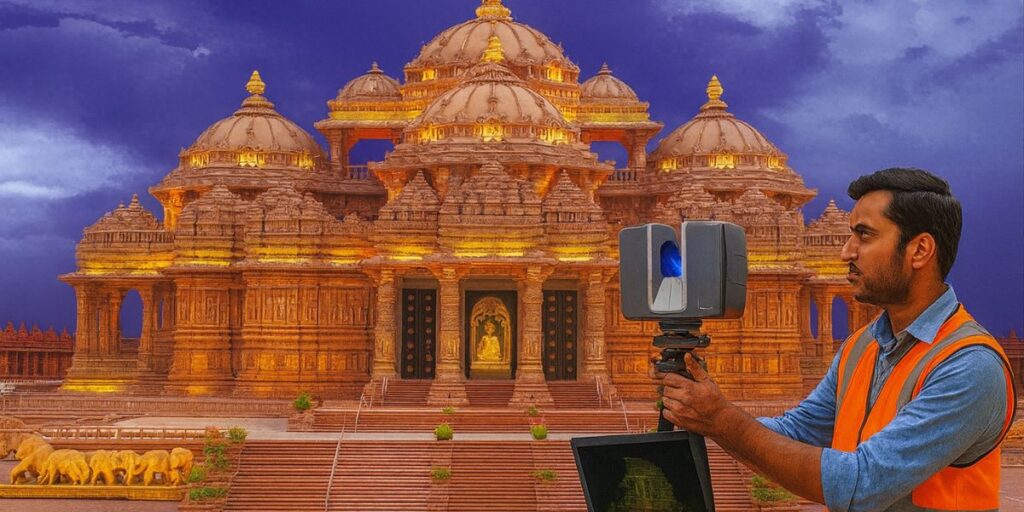
LiDAR (Light Detection and Ranging) has transformed temple archaeology in India by capturing high-resolution images even in dense or obstructed environments.
✔ Why it’s important
- Helps locate buried or collapsed temple sections
- Maps surrounding ancient settlements
- Supports accurate, non-invasive restoration
✔ Case Studies
- In Hampi, LiDAR helped identify lost water systems and structural alignments of Vijayanagara temples.
- Ayodhya Ram Mandir development used LiDAR to map land contours and underlying geologies.
Also Read: Valley of Flowers Is Not Just a Trek – It’s India’s Hidden Valley of Gods
3. Ground-Penetrating Radar (GPR): Understanding What Lies Beneath
Before any restoration begins, engineers need to know what’s under the temple structure.
GPR emits radio waves into the ground to detect cavities, ancient foundations, or weaknesses.
✔ Applications
- Avoiding damage to ancient foundations
- Locating buried pillars or mandapas
- Predicting areas prone to sinking or cracking
This has been crucial for temples in Tamil Nadu and Odisha, where underground water channels affect structural stability.
4. AI-Based Digital Restoration & Virtual Modelling
AI is now used to reconstruct missing carvings, motifs, and architectural elements based on historical data.
✔ What AI helps with
- Predicting missing patterns
- Restoring broken sculptures digitally
- Creating exact replicas for reference
- Ensuring culturally accurate restorations
AI-powered models were used during conservation initiatives around the Sun Temple, Konark, helping reinterpret heavily eroded sculptures.
5. Digital Archives: Preserving India’s Temple Heritage Forever
For the first time, India is building nationwide digital archives of temple architecture.
✔ What is being archived?
- Sculptures
- Inscriptions
- Floor plans & blueprints
- Historical documentation
- 360° virtual walkthroughs
This ensures that even if a structure deteriorates over centuries, its knowledge remains accessible forever.
✔ Example
The Indira Gandhi National Centre for Arts (IGNCA) and ASI are collectively digitising thousands of temple manuscripts, inscriptions, and architectural drawings.
6. Structural Health Monitoring (SHM): Continuous Protection
Many temples now have sensors to monitor:
- vibration levels
- moisture
- pressure on beams
- foundation movement
This helps prevent collapse and supports timely maintenance.
✔ Example
The Brihadeeswarar Temple (Thanjavur), built in 1010 CE, has been studied using advanced structural monitoring to understand why it survived 1000+ years.
7. Earthquake-Resistant Restoration Techniques
India’s ancient temples were often designed with seismic intelligence—interlocking stones, floating roofs, load-sharing pillars.
Modern conservation uses this knowledge along with:
- micro-concrete injections
- stainless steel reinforcement
- base-isolation retrofitting
This preserves the original design while adding long-term safety.
8. Revival Through Community Participation & Technology
Technology is only one part—India’s revival movement is also powered by:
- local artisans
- traditional sthapatis
- temple scholars
- conservation students
Together, they make restoration more grounded, authentic, and culturally accurate.
Section 3: FAQ (SEO-Friendly)
1. How is technology helping restore ancient temples in India?
India uses 3D scanning, LiDAR, AI modelling, radar surveys, and digital archives to restore temples with scientific accuracy while preserving traditional architecture.
2. Which Indian temples are being restored using modern technology?
Temples in Kashi, Puri, Hampi, Thanjavur, Ayodhya, and across Tamil Nadu and Odisha have all benefited from advanced conservation technologies.
3. Why is it important to revive ancient temples?
Temples represent India’s cultural identity, architectural genius, spiritual heritage, and historical continuity. Restoring them preserves knowledge for future generations.
4. What is LiDAR and why is it used in temple restoration?
LiDAR is a remote sensing technology that creates precise maps of structures and landscapes, helping archaeologists identify hidden features and restore temples accurately.
5. How does India balance tradition and technology in restoration?
India combines modern tools (3D, LiDAR, AI) with traditional sthapati wisdom, ensuring restorations are authentic, respectful, and long-lasting.




Pingback: Why Presence Matters More Than Statements in Global Politics - indiauncovered.in